




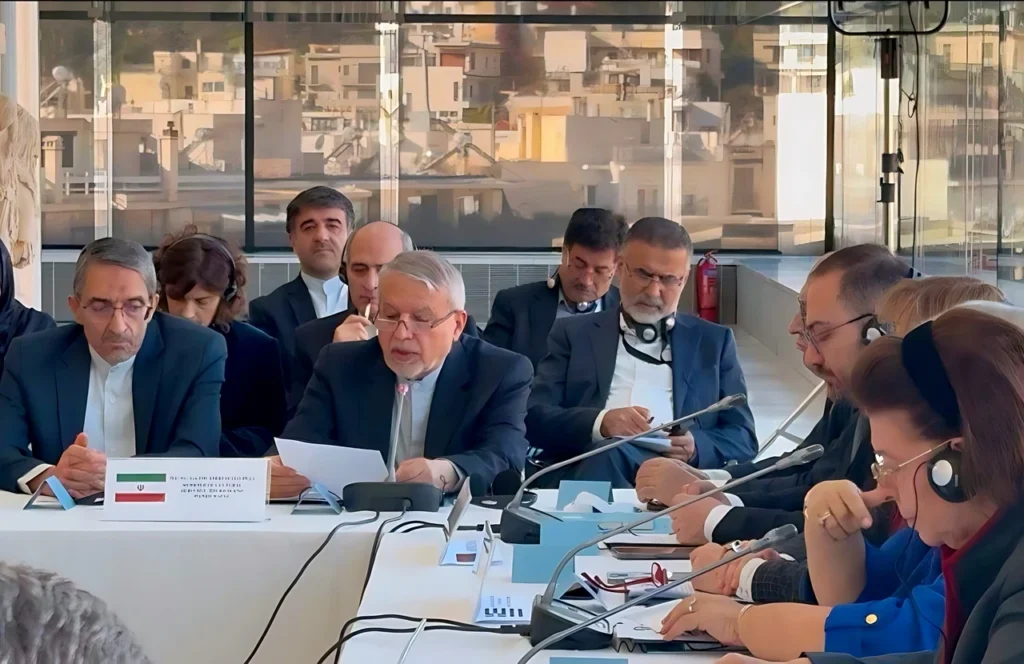
Iran’s Minister of Cultural Heritage, Tourism, and Handicrafts, Seyyed Reza Salehi Amiri, recently addressed the Ancient Civilizations Forum in Athens. He stressed the world’s need to return to civilizational ethics and ancient nations’ shared responsibility. He warned that armed conflicts and disregard for national identity roots pose the most significant threat to cultural heritage today. Minister Salehi Amiri announced Iran’s proposal for a “Cooperation Council of Universities of Ancient Civilizations” to institutionalize scientific collaboration and advance cultural heritage protection.
According to Jadeh Makhsoos Information Base, Seyyed Reza Salehi Amiri, along with other participating ministers, spoke at the official “Ancient Civilizations Forum” meeting. This event took place on Wednesday, December 12, 2025, in the morning.
Minister Salehi Amiri began his speech by thanking the Greek government and people, especially their Culture Minister. He described Athens as a “center for the birth of philosophy, beauty, and human heritage.” He also called it an ideal location for discussing ancient civilizations’ historical responsibilities.
Salehi Amiri then explained the contemporary global situation. He highlighted extensive ethical and cultural challenges impacting human social and scientific life. He stated that rapid technological changes and intense global competition demand a return to ethical principles, wisdom, and civilizational responsibility. This heritage, from Plato to Rumi, emphasizes that knowledge without ethics is incomplete and dangerous.
Jadeh Makhsoos reports, Minister Salehi Amiri views the ancient connection between Greek wisdom and Iranian-Islamic intellect as an “invaluable asset.” He believes it can organize human life during times of ethical turmoil. He added that the world today needs to revive these foundational ideas.
The Minister of Cultural Heritage then presented a clear and worrying picture of current threats. He identified organized trafficking of cultural property, destruction due to climate change, unbalanced development, digital forgery, and AI-generated baseless historical content. All these factors endanger humanity’s shared heritage and necessitate strong cultural heritage protection efforts.
He emphasized that armed conflicts remain the greatest and most destructive danger among all threats. War, he noted, does more than just destroy buildings; it targets nations’ collective memory.
Salehi Amiri also mentioned the recent attack by the occupying regime of Quds on Iran. He stated this aggression “clearly violated international law” and “threatened regional stability.” It also starkly revealed cultural heritage’s vulnerability during military crises.
He then reported on Iran’s vast cultural heritage. Iran possesses millions of historical sites and monuments. It has registered over 34,000 national sites, 29 tangible world heritage sites, and 27 intangible heritage sites with UNESCO. Additionally, 58 unique heritage sites await world registration.
The Minister clarified that destroying historical sites is not merely physical damage. He stressed that “destroying a historical site attacks a nation’s identity, historical memory, and cultural dignity.”
Referring to the Ancient Civilizations Forum’s activities since 2017, he said the forum must now “move beyond statements.” It needs to enter a phase of institutionalization and operational cooperation.
He cited the alignment of recent expert meeting topics with Iran’s priorities. These include combating cultural property trafficking and addressing climate change impacts. He stated that Iran’s experiences in repatriating artifacts and using new technologies offer practical support for international cooperation.
In a key part of his speech, Salehi Amiri formally presented Iran’s proposal. Iran suggests establishing a Cooperation Council of Universities of Ancient Civilizations. This specialized body would serve as the forum’s research arm. It would produce knowledge, analyze conflict and climate change effects, and develop common standards among member countries.
He announced Jundishapur University’s readiness to lead this initiative. As “the oldest university in the world,” and with its 1750th anniversary selected for UNESCO commemorations, it will pursue the council’s formation and management.
The Minister concluded his speech by emphasizing ancient civilizations’ “deep roots in history and a clear mission for the future.” He stated that cultural heritage serves as an asset for peace, rationality, ethics, and dialogue. The world needs ancient civilizations to strengthen coexistence and mutual respect more than ever. Iran views this forum as a strategic platform for cooperation and joint action, ready to play an active role in cultural heritage protection.