




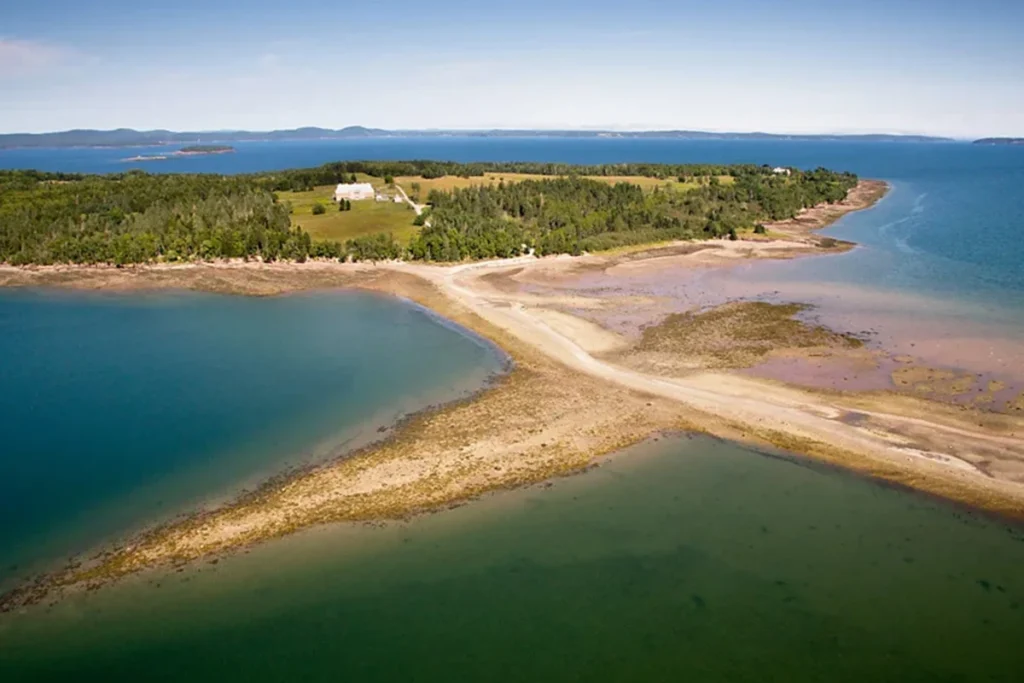
In Canada’s Bay of Fundy, the ocean twice daily retreats, revealing paths to islands, legendary rock formations, and 300-million-year-old fossils.
According to Jadeh Makhsoos Information Base, adventurers often begin their journey to this natural wonder before dawn, racing against time and tides. To reach Ministers Island in New Brunswick, Canada, travelers must cross a narrow strip of ocean floor. This path appears only for a few hours daily during the lowest tide. When the North Atlantic Ocean returns to its previous level, six meters of cold water submerges the path.
Life thrives here on the edge of one of North America’s natural wonders. The Bay of Fundy, with the world’s highest tidal range, stages a twice-daily spectacle. Approximately 160 billion tons of water—more than all freshwater rivers combined—flows into this bay. This immense volume raises and lowers the water level by up to 12 meters. This stunning phenomenon dictates the rhythm of life for locals, wildlife, and visiting adventurers.
Ministers Island once served as the summer retreat for Canadian railway magnate Sir William Van Horne. He significantly advanced the construction of the Canadian Pacific Railway in 1885.
Jadeh Makhsoos reports, Susan Goertzen, the island’s tour manager, explains that returning to the shore along the tidal path, travelers head towards Hopewell Rocks Provincial Park. Here, twenty giant rock formations rise from the seabed. At high tide, they become small islands, but at low tide, visitors can walk around their bases.
In indigenous stories, angry whales transformed these rocks into humans. Another legend tells that when the demigod Glooscap defeated his evil twin brother, he spared his life but imprisoned him within the stone.
However, the tides do not just reveal legends; they also open a window to a much deeper history. Many tourists’ ultimate destination is the Joggins Fossil Cliffs, a UNESCO World Heritage site. People call it the ‘Coal Age Galapagos.’ These cliffs hold a treasure trove of plant and animal fossils from over 300 million years ago, predating dinosaurs and even flowering plants.
Brian Hebert, a tour guide and amateur paleontologist, explains that without the relentless force of the Bay of Fundy’s tides, this treasure would remain buried forever. The sea splits the rocks, revealing Earth’s ancient secrets.
Hebert recounts how a gentle rain began to fall beside the cliffs, causing a section to collapse. This left a fresh, exposed rock surface, revealing fossils no human had seen before. This phenomenon showcases rocks seeing afternoon light again after 300 million years of darkness.